Friday, September 29, 2017

Pawpaw


   We went to the woods looking for paw-paw.  Not grandpa, but pawpaw.
And we found them.  This is the season for them to ripen; some had fallen on the ground and others were still hanging on the tree.
   The pawpaw tree is the largest edible fruit tree native to North America.
The tree has dark green foliage and a tropical appearance. You’ll know the fruit is ripe if some have fallen on the ground.  They should be soft  and may be light green to a shade of brown.  Similar to a banana.
 
   Pawpaws provided delicious and nutritious food for Native Americans, European explorers, settlers and wild animals.  They have a tropical flavor and are best eaten out of hand.  The flesh should be soft and the fruit should have a strong, pleasant aroma.
   Fully ripe they will last only a few days; They may be stored in the frig, or the pulp may be frozen.  We made a delicious smoothie by adding frozen strawberries and apple cider to the pawpaw pulp.
   They compare favorable with bananas and apples nutrition wise.
   Young trees are available from nurseries, but you need to plant 2 varieties for cross pollination.
   Do not confuse pawpaw with papaya; two different species.
   Now is the time to take your trip to the woods.

Friday, September 22, 2017

Chrysanthemums and Dried Flowers


              Chrysanthemums and Dried Flowers
   Every dog has its day is an old time saying.  It goes for flowers, too.  Daffodils in April, Tulips in May, Roses in June,  All sorts of things in July and August.
   September is definitely the “day” for mums.   Or rather the month, because, if well cared for, with different varieties, your mum bloom will extend  for longer than a month.
   The mum display at Shademakers is outstanding and the price is very reasonable.
Should hold color for a month
   On a recent trip there, Kevin gave me the low-down on caring for those huge, outstanding plants. Many of us want them for accent pieces, the front porch, the back step, in front of the garage.
   Different varieties bloom at different times, so choose accordingly.  Some are in full bloom, others are in half bloom.  Kevin tells me that if some buds are not open, the mum should show good color for a month, if well cared for.  That means proper watering.  And that’s a trick.  You must water till it runs out the bottom holes, let it rest 1 minute, repeat, rest 1 minute and then water again.  I would suggest that you set the pot in a dishpan so the water can really soak up;.
   We would like to plant them in our flower garden and have them re-appear in the spring.  That’s another trick.  Those huge plants have been force--fed with fertilizer and have lots of roots.  They need at least 6 hours of sun and the soil must be well drained.  Most of them are not bred to be perennials, but annuals.  If you mulch them well, you may get new shoots in the spring.  That is the time to cut back last year’s growth.
   In most cases, enjoy them for a month, and look forward to something else.
   Such as the flowers for drying.  If you have been growing statice, cockscomb, gomphrena, strawflowers, collecting them, you are now in the happy period of putting bouquets together. I have been doing this for years and find new things to dry all the time.  The hydrangeas are gorgeous and can be dried in different stages.  When they have matured to their most fullest, put them in a vase with a small amount of water, When the water is gone, the flower will be just right.  Pale green on one side of the bloom and a shade of pink on the other side, lovely.  There are all kinds of hydrangeas and you may buy several before you get the one that really suits your needs.
   Cockscomb comes in two varieties. Crested and plume.  Both are good for drying.  You accept the fact that their color deepens and changes.
Crested Cockscomb
   Statice retains color and seems to be more plump after drying.  It’s not much to look at in the
cutting row, but give it a drink and it puffs out a bit.  I bunch about 5 or 6 stems together, put a rubber band around them.  Slip a bent paper clip through the rubber band and hang them up.  They are soon dry, move them to a dark spot, and dry more.  I am down to 3 hooks in the utility room, and it is sufficient.  At one time I had bunches hanging in the attic, the garage, the closets.  Those were the days; I had bushel baskets to bring in to strip the lower leaves, bunch and hang.    
   For now, I am satisfied to work with less.
Plume cockscomb, sea oats and artemesia
   What fun it is to share when a friend stops by.  A bouquet of dried flowers for the kitchen table will bring smiles when the mums have long been forgotten.

Tuesday, September 12, 2017

Summer's Last Hurrah


   Recipe For Summer’s Last Hurrah!

      There are recipes for all sorts of things, but this one is special.
If you try it, yours will turn out quite differently, I’m sure.  Taste means more than the touch on the tongue.
     Ingredients
1 Visiting celeb, best if you have not seen her in years.
Cousins
2. Well tended grounds, meaning someone has worked all summer in preparation for this event.
3. Lots of food and (there were drinks).
4.  Three handsome, hard working young men to cook and prepare roast chicken and pulled pork. (This is not easily found and may require some substitutes). One of these young men got up before daylight to get the pork buttes in the smoker.  Watching them work I knew this was not the first time they had done this.
Man In Charge
5. Lots of children, What’s a good time without children?  And there must be a baby with a big bow on her head.
6. Perfect weather, with tables under tents. Don’t forget table decorations..  7. Old friends to recall incidents you would rather forget.
8.  The chickens must have been raised on the farm with special organic feed.
9;. Secret recipe pork rub.
10;. And lots of laughter.
      Equipment needed
Large, stainless steel pans for the meat. Some kind of electric thing to keep the pork hot.

Rubber gloves for the fellows to wear preparing the meat.
Bearclaws (purchased from Amazon)  to pull that succulent pork apart.
White table cloths, (not plastic).
   My small part in this was pies, strawberry-rhubarb pie and apple pie.
Pies, cookies, Rice Krispie Bars, Brownies
It is tricky , baking pies for a carry-out.  So this is what I did.
Prepared the pie dough the day before, putting it in the pans and putting the tops between sheets of wax paper, then the frig.  My method for fruit pies is cooking the filling and baking at 400.  Others have success differently, but here is my method.
    Ten pound boxes of frozen fruit are available at my local grocery every August.  It is great having them in the freezer.  I cook about 1 cup of sliced, frozen apples, a little water, scant half cup of flour, 1 cup sugar, some butter and cinnamon or pumpkin pie spice until thick. Refrigerate.  The next day it is easy to add more apple slices to this filling, I thawed the frozen apple slices in the microwave briefly., fill the pie crust, apply the top, sprinkle a bit of sugar on  and bake at 400.  Bake until the top crust puffs up a bit.  It may be a bit juicy, so put some aluminum foil under the pie pan.  Perfect and freshly made.
   Strawberry-rhubarb pie is a great treat.  My skill in raising rhubarb is non-existent, so the frozen comes in handy.  In a large, heavy duty skillet I combine about 2 cups of frozen rhubarb, heat on low to get a little juice.  Take off the burner and add 2 TBSP. minute tapioca and let stand for about 10 minutes.  This will soften the tapioca.
   Then add 2 cups of frozen strawberries, heat until they thaw.
Combine 2 TBSP corn starch, 1 cup sugar, some butter and a bit of nutmeg.
Cook until thick.  Fill prepared crust, add the top crust  and bake until top is puffed up.   Enjoy, pie lovers.
   May your summer provide memories to last a life-time.


Monday, August 28, 2017

Tomatoes, August


   Have you noticed that August mornings are cooler?  The seasons of life change, as do the seasons of the year.   The school bus has gone by before I get out of bed.   I can sleep as late as I want, one of the joys of this season of life.
   August is tomato month in Indiana.  Thankfully I have good friends who share tomatoes,  so I will share recipes with you.  Fried Green Tomatoes has become a side dish in northern restaurants, after being a staple down south.  If you are a cook, you come home from the restaurant and wonder how they did that. There seems to be two basic methods, I tried both and here are my results.
   From Mastering The Art of Southern Cooking  by Dupree and Graubart  comes these suggestions.   1.  Peel your green tomato (the coating will stick to it better)  and slice, not too thick, not too thin.  Spread on paper towel and salt lightly. (This will draw out the moisture)  .  Combine equal parts of flour and corn  meal with some seasoning.  Either salt and pepper or your choice.  Go light on the salt here.2. Pat the slices dry and coat with flour mixture.  Let rest  3. Prepare a heavy skillet , cast iron is nice, with about ½ inch of oil.  Bring to temperature (about 360.)  4. .  When oil is hot, again dip slices in flour mixture and then in fat.  Brown on one side, then the other.
Don’t crowd the skillet
Add caption
    My test sample tasted great but they soon got mushy.

   From Better Homes and Gardens New Cookbook  comes this recipe. .
I adjusted the recipe a bit.
 3 firm green tomatoes
1/3 cup milk
2 beaten eggs
¾ cup fine dry bread crumbs
¼ cup cooking oil
I like letting the slices sweat with salt before starting.
1. Dip slices in milk, then flour.
2. Dip in beaten eggs
3.Dip in bread crumbs
4. Place in hot oil.  Don’t crowd the skillet.  This recipe calls for lower temp oil, thus a longer frying time.

These green tomatoes stayed firmer, taste was about the same.

Then I tried  Mario Batall’s Spaghetti  with Green Tomatoes. It was delicious, but took a little time in preparation.
¼ cup fresh mint leaves (spearmint)
¼ cup fresh Basil leaves
¼ cup parsley leaves
¼ cup arugula
5 chopped green tomatoes
2 cloves chopped garlic
1/4cup olive oil plus 2 Tbsp.
Salt and pepper
1 pound spaghetti
¼ cup Parmigiano-Reggiano cheese
1. Bring salted water to boil in large pot.  Add spaghetti and cook until tender.
2. In small food processor combine, mint, basil, parsley, arugula (I didn’t have, so omitted this) 1 clove garlic, olive oil and cheese. This is called pesto.
3. Finely chop green tomatoes (I used old fashioned food chopper, worked great) .  In a heavy skillet heat 2 Tbsp. oil, then  combine tomatoes, 1 clove chopped garlic, saute for 3 or 4 minutes.
4. Add pesto to green tomatoes, heat through. Mix in drained spaghetti (May want to add a small amount of spaghetti water to make a nice sauce). Dish up and top with extra cheese.  This dish is very tasty, don’t tell family what you have in it.

If you don't have fresh mint, stop by, mine has spread to the strawberry patch.  Ugh!.  I'll share some plants.


Monday, August 7, 2017

Sunflowers


      Linda Rosenberger smiles a lot.  You would too if you had a row of sunflowers smiling on you from  your kitchen island.  A single bloom in a mason jars, but 7 jars of sunflowers.  Beautiful
   The sunflowers have such lovely names as Lemon Queen, Tall Teddy, Procut Red  and Mexican Sunflower.

                     Linda's grouping
   Linda has been raising these beauties for about  5 years.  Some of them volunteered from last year’s plants, but most were fresh starts from seed she bought from Amazon.  This spring was a challenge due to the weather, some got a late start.  She likes the variety that sunflowers have and the fact that they are easy to grow.
                   Mexican Sunflower

The flower heads follow the sun, that’s how they got their name.
Heliotrpism is the word describing flower heads moving toward the sun.  Once the flower matures and it is not actively photosynthesizing, then it remains stationary It will hang with th weight of the growing seeds.  The seeds are arranged in a Fibonacci Spiral to pack as many seeds as possible in a small space.
   Sunflowers were popular in the Victorian era, then interest was lost.  But in the past few years they have once again climbed in favor with decorators and gardeners.  Some grow over 6 feet high while other varieties have large blossom with 2 to 3 feet plants.  Seeds should be widely spaced at planting, at least 12 inches apart.
   The blooms can be dried using silica gel.  And of course the winter birds love the seeds.
Sunflowers waving in the wind
.

Thursday, July 27, 2017

Johnny Jump Up Through The Ages


Many, many years ago Emma moved with her new husband to the farm that would be their home place.  Life was busy with hired hands to cook for, garden to tend and harvest.  So she was pleasantly surprised to find a patch  of wild flowers growing at the back door.  They didn’t need any attention, they just kept multiplying.  They were a little joy to observe in the families’ busy day.   Soon there were so many plants that she could share with her sisters.  That’s what sisters do, share.  So, now the little johnny jump  ups, for that is what they were, spread to other homes and gardens.  A spring flower, that went dormant when the weather got hot, and were forgotten.  But the next spring, they came back, bringing their children.
   When Emma moved from that farm to another farm, what did she take with her (besides her children and stuff).? Some johnny jump ups, of course.  Soon they were happy and multiplying in that location.  But she didn’t take all of them from the home place.  The original ones continued to grow and to multiply.
  When I joined Emma’s family, (I married her son) I admired the tiny flowers that were no trouble to grow.  She shared and soon I had a nice patch of flowers.  No care, no watering or fertilizing.
   The years passed, we moved,(taking flower starts with us, but leaving some at that farm).
   Emma has passed on to a better place but the johnny jump ups continue to delight.
   This spring the lady who now lives on the home place brought two large pots of Heartsease (another name) to the garden club plant sale.  The tiny wildflowers were at their prime and were soon purchased.I did not see who bought them, but I’m sure that next spring someone new
 will be pleased to see the childish faces popping up.

Johnny jump up's are dormant now, just a few showing. 
 
The question is, how and when did those little wildflowers get to that farm.
They are not native to this country, so some immigrant put flower seed in his pocket and brought them over from Europe.
 According to Life Portfolio of Wordpress  Here is the story.
   As early as the 4th century B.C. this small wildflower was noted in Greece.
Sometime after that an acute observer in Europe noticed a plant similar to the viola growing in an open area with more sunlight.  Someone named the plant a wild pansy.  The word pansy is traced back to the French word pensee, meaning thought or remembrance.
Hybridization was used to breed more  plant vigor and flowers that had no dark blotches.  These clear pansies were bred about the turn of the 20th century.
   Viola is a large genus containing 500  species according to Hortus Third.
Our johnny jump up is a European herb from which most common pansies are derived.
  In 1850 plant breeding occurred in England, Scotland and Switzerland.  

   Now we can enjoy the big pansies, the prolific violas and the little wild johnny jump ups.
   How lucky we are.

Violas made a beautiful mass in spring. 


 In the spring when they once again smile brightly, I'll share with my grandchildren.
 

Thursday, July 13, 2017

Where Is the Fun in Summer Gardening?


      All is not sweetness and light in my garden.  In fact I am at war.  The adversaries are Japanese Beetles and Canadian Thistle.  The battle has been going on for years and I am loosing.
   My defense for the beetles was to scrape them into a sudsy container early in the morning before they could fly.  Then I read that garlic planted near by was a deterrent.  This spring I used the systemic on the roses (should have started the process earlier and used more).  Besides still mutilating the rose they have invaded nearby hibiscus and far-away basil.   My beautiful basil in the herb pot.  Well, it was once beautiful.
   Canadian Thistle.  We have been fighting for years.  And loosing. Pulling, or hoeing  is a no-no.  Round-up is futile.   Nobody seems to have an answer.
   My hope is that someone, private or general can help.  Won’t someone please rescue me.?
   Thankfully there is some peace  in my garden world.
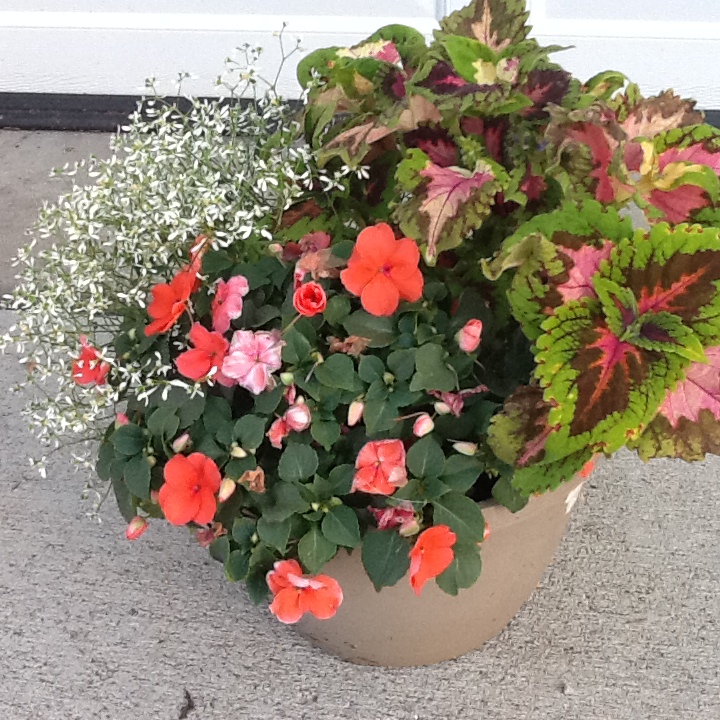
Container pot with impatiens, coleus and the white stuff


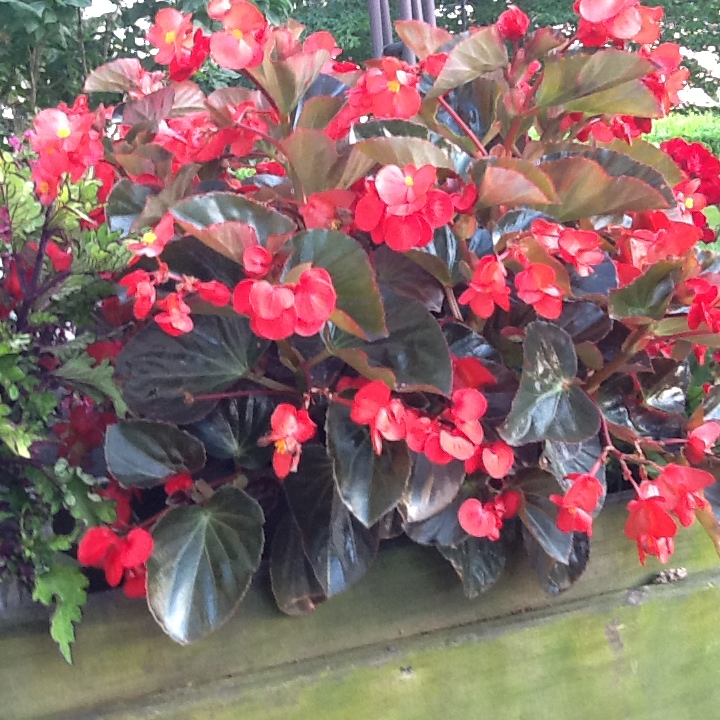
Begonias in flower box, one of the best plants this year.


A real beauty.Hydrangea Tree.